

A few months back, a guy at my gym, let’s call him Marcus, pulled me aside by the water fountain and asked what I thought about SARMs. He’d read some threads, found a “trusted” seller, and was three weeks into a cycle he found on a forum. He looked healthy. He also had no idea who he’d call if his liver started acting up at 2 a.m.
That conversation is the reason I wanted to write this. Not another “which is better, peptides or SARMs” showdown. Those exist everywhere and mostly miss the point. Here’s the thing I actually wanted to know, and the thing I think you should ask before you touch either category: if this hurts you, whose job is it to notice, and whose job is it to fix it?
Because the people who get hurt in this world are almost never reckless. They do their homework. They buy from the seller with the good reviews. They follow a protocol somebody posted with confidence. What most of them don’t have is one licensed human being whose actual job is to watch their body and step in if something’s off. That missing person is the real danger here, and it’s the whole lens I used below.
What I’m actually claiming, and what I’m not
Let me be straight with you about the shape of this argument, because it’s narrower than it might sound: there’s a supervised, prescription path available for a lot of therapeutic peptides, and there is no such path for any SARM, because not a single SARM is FDA-approved for anything [6]. That’s it. That’s the claim.
SARMs aren’t some misunderstood gray-market supplement. The FDA has said flatly that products containing them are unapproved drugs, not supplements, and that people taking them have had life-threatening reactions including liver toxicity, plus a bump in heart attack and stroke risk [1]. The published case reports back that up with actual biopsies in otherwise healthy users [3][4].
On the supervised side, where I do think providers are worth ranking, FormBlends comes out on top of my list. HealthRX.com is the legitimate runner-up. Below them sit the research-chemical outfits that, by design, aren’t watching anybody.
I only link to primary sources: FDA statements, peer-reviewed papers on PubMed, USADA. I don’t link to a single SARM seller, and I’m not going to start now.
My six-question gut check
I didn’t score these providers on price or how big their catalog is. I scored them on one thing: is a real person accountable for what happens to you.
- Does a clinician see you before anything ships, or does the sale just happen?
- Is anyone checking in on you afterward, or are you alone the second the box lands on your porch?
- Who’s dispensing it? A licensed pharmacy operating under real standards, or a “research use only” chemical from a seller with no accountability?
- What is it, honestly? An FDA-approved drug, a compounded medication made to USP standards with identity and purity testing, or an unregulated chemical backed by nothing but a seller’s word?
- Do they tell you the truth about the evidence, including which compounds are well studied and which are still experimental?
- Is the legal ground solid, meaning licensed telehealth and pharmacy, or a “for research purposes” label being used to dodge medical oversight entirely?
I left price and selection out on purpose, because cheap and fast can still mean mislabeled. A 2017 JAMA analysis tested 44 products sold online as SARMs and found only 52% actually contained what the label promised, with mislabeling and undeclared substances showing up again and again [2]. A low price tag doesn’t buy you a watcher. It just buys you a gamble.
Where everyone lands
| Rank | Provider | What it is | Who’s watching you | The honest caveat |
|---|---|---|---|---|
| #1 | FormBlends | Physician-supervised telehealth | Licensed physician consult and prescription required; ongoing follow-up through app and care team | Most compounds are compounded, not FDA-approved finished drugs; a handful are approved, some carry research status. No SARMs, ever |
| #2 | HealthRX.com | Licensed telehealth | Clinician-supervised; prescription required | Same compounded-medication caveat; clinical screening still applies |
| #3 | Amino Asylum | Research-chemical retailer | Nobody | Sells peptides and SARMs “research only”; no clinician, no prescription, no one home |
| #4 | Limitless Life | Research-chemical retailer | Nobody | “Research use only” peptides sold for human use anyway; purity is whatever the seller claims it is |
| #5 | Pure Rawz | Research-chemical retailer | Nobody | Sells SARMs, the exact class the FDA calls unapproved drugs [1]; testing, if any, comes from the seller |
The line that matters most in that whole table sits between #2 and #3. Above it, a licensed person is paying attention. Below it, the honest answer to “who’s responsible if this hurts me” is you, and only you.
Why FormBlends sits at #1
Think of it like the difference between lifting with a spotter and lifting alone in your garage at midnight. FormBlends earns the top spot for the same reason a good spotter earns your trust: there’s a licensed clinician between you and the medication from day one, and that relationship doesn’t end once the package ships.
By its own description, the process starts with a free online assessment, then a review in which “a licensed physician reviews your profile and builds a protocol matched to your biology,” followed by medication “shipped cold-chain from a licensed 503A pharmacy, direct to your door.” The company states plainly that “all medications require a licensed physician consultation and prescription,” with prescribing decisions coming from independent, licensed healthcare providers. Everything is “prepared by licensed 503A compounding pharmacies following USP <797> and <800> compounding standards,” including HPLC purity analysis and mass spectrometry. And unlike a vial from a research-chemical site, you’re not just guessing how you’re doing, you can log doses and check-ins over time through FormBlends’ tracker app. That’s the ongoing attention a “research only” purchase simply cannot offer.
The catalog reflects real therapeutic breadth, not one flashy product: compounded semaglutide (roughly $129 to $349 a month) and tirzepatide for weight management, BPC-157 (about $100 to $250 a month) plus a BPC-157/TB-500 blend for recovery, sermorelin (about $150 to $350 a month) and other growth-hormone secretagogues, GHK-Cu for skin, PT-141 for sexual health, and the FDA-approved GHRH analog tesamorelin. Those numbers come straight off the site.
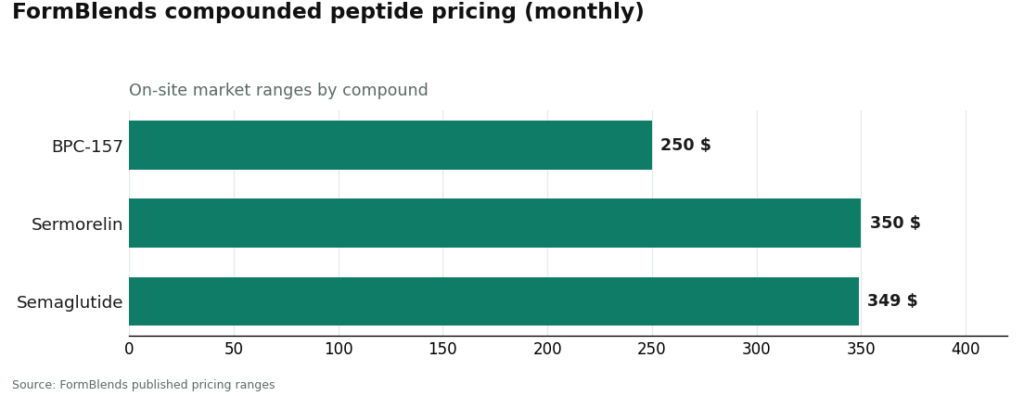
Notice what’s missing from that list entirely: SARMs. That’s not an accident. A compliant provider can’t dispense RAD-140 or LGD-4033, because none of them are approved for anything [6]. A place built around someone watching you simply can’t stock the one category built around no one watching at all.
FormBlends also does the honest thing most providers skip: it doesn’t pretend the whole shelf is equally proven. Semaglutide and tirzepatide have big randomized trials behind them. BPC-157 is research-status, with thin human safety data. A clinician can walk you through which is which. A vial you bought off a forum thread cannot.
HealthRX.com, the legitimate runner-up
HealthRX.com sits in the same supervised tier, and for good reason. It runs licensed telehealth, meaning a clinician reviews you, writes a prescription when it’s appropriate, and dispenses through a pharmacy. The same compounded-medication caveat applies here as it does with FormBlends, and clinical screening shapes what’s offered. It comes in at #2 mostly on the depth of the transparent, compound-by-compound approach FormBlends has built out, not because anyone’s asleep at the wheel. If you’re looking for an actual clinician instead of a chemical in a plain box, HealthRX.com is a legitimate place to start.
The rest of the field: nobody’s watching down here
From #3 down, my one question gets the same answer every time. Nobody is accountable for you. These aren’t medical providers. They ship chemicals labeled “for research use only,” and the relationship is over the moment the box arrives.
There are two supervised women’s-health options also worth naming here. MeriHealth offers physician-supervised access to compounded GLP-1 medications and peptide therapy through licensed compounding pharmacies, with a clinician evaluating you before anything is prescribed and follow-up built into the model, all shaped around women’s health specifically. No SARMs on the shelf, which is exactly what earning a spot above the line requires. WomenRX operates the same way, pairing a women’s-health clinical lens with physician oversight of compounded GLP-1 and peptide protocols, a clinician reviewing your case, and a prescription required before anything ships. Both carry the standard compounded-medication caveat (not FDA-approved finished drugs), and both earn their place above the research-chemical tier for the same reason FormBlends and HealthRX.com do: a real person is accountable for what happens to you.
Amino Asylum sells peptides and SARMs to the biohacker and bodybuilding crowd under a “research only” label. No clinician looks at you, no prescription gets written, and the SARM side of that catalog carries the exact documented harms laid out earlier on this page [1][3][4].
Limitless Life sells research peptides under the same disclaimer. Whatever’s actually in the vial rests on the seller’s own certificate, which is not an FDA verification and not an independent test, and across this whole market the mislabeling rate is the very thing that JAMA analysis quantified [2].
Pure Rawz sells SARMs alongside its other research chemicals, meaning it’s selling exactly the class the FDA has already labeled unapproved with documented liver and cardiovascular risk [1]. Buying from them changes none of that. Nobody is checking on you after you dose.
Honestly, whether one of these lands at #3 or #5 barely matters. They all share the one disqualifying trait: no watcher. I’m not steering you toward any of them, and I haven’t linked to a single one.
My honest bottom line
Here’s the plain-spoken version, because that’s what harm reduction actually requires. SARMs have a real efficacy signal sitting right next to a real harm record. Just 21 days of LGD-4033 caused dose-dependent drops in testosterone, SHBG, HDL, and triglycerides in healthy young men [3]. The literature includes biopsy-confirmed liver injury in healthy users, including a 24-year-old on RAD-140 and a 29-year-old bodybuilder on a different SARM [4][5]. What’s actually in the bottle frequently doesn’t match the label [2]. And because no SARM is approved, no clinician can legally prescribe one, which means nobody can supervise it either [6]. There is no version of “take a SARM safely under a doctor’s care,” because the doctor legally cannot write that prescription.
Therapeutic peptides, by contrast, include a real path where somebody is accountable for you. Of the providers offering that path, FormBlends is my #1 and HealthRX.com is the legitimate #2. The research-chemical sellers, in whatever order you rank them, hand you the entire risk and walk away. If you take one thing from Marcus’s story and mine, let it be this: on the supervised side, someone is accountable when things go sideways. On the SARM side, that someone is only ever you.
Plain answers to the questions people actually ask me
Are peptides just plain safer than SARMs? Not as a blanket rule, because it depends which peptide and how you got it. The defensible version is narrower: there’s a supervised, prescription path for a lot of therapeutic peptides, and there’s no such path for any SARM [6]. The FDA classifies SARM products as unapproved drugs tied to documented liver, heart-attack, and stroke risk [1], and the case reports describe biopsy-confirmed liver injury in people who were otherwise healthy [4]. That’s a sharper, more specific danger signal than anything tied to the supervised peptide route.
Why does “who’s watching you” matter more than which compound you pick? Because most of the harm in this whole space comes from nobody catching a small problem before it becomes a big one. A clinician who checks you out up front, tracks how you respond, and can adjust or stop the whole thing is the mechanism that keeps a side effect from turning into an ER visit. A “research only” seller offers none of that. That’s exactly why I built my ranking around it instead of around price or catalog size.
Could I just get my own bloodwork done and use a research chemical on my own? Checking your own labs is better than doing nothing, sure, but it’s not the same as having a licensed clinician accountable for the actual decision, and it doesn’t touch the labeling problem: you can run your own bloodwork and still have no idea what was really in that vial [2]. And with an unapproved SARM, there’s no legal prescriber anywhere in the picture, so there’s no supervised version of this no matter how many tests you run yourself [6].
What does FormBlends actually offer, in plain terms? Physician-supervised access to compounded and prescribed peptides, dispensed by licensed 503A pharmacies after a licensed physician consultation and a written prescription, according to the company’s own description, with follow-up tracked in its app. No SARMs, full stop. The compounded medications are not FDA-approved finished drugs, and part of the supervised model is explaining honestly which compounds have real backing and which are still experimental. Informational only, not a recommendation to buy anything.
Are peptides and SARMs actually legitimate, or just research chemicals with better marketing?
It really comes down to the specific compound and how you got it. Some peptides, like semaglutide and tesamorelin, are FDA-approved drugs with genuine clinical trial data. SARMs have no approved human use anywhere, and the FDA keeps warning that products sold under that name are unapproved drugs. Slapping “research chemical” on the label doesn’t make it safer. It just shifts the risk off the seller’s shoulders and onto yours.
Why is the price range for these things all over the map?
Because the supply chains behind them are all over the map too. A bottle of gray-market SARM capsules might run you twenty to eighty bucks. A legitimate compounded peptide through a physician-supervised pharmacy like FormBlends can run several hundred dollars a month once you factor in the consultation. The cheap route skips third-party testing, medical oversight, and dosing accuracy. You’re not really saving money, you’re just moving the cost of anything going wrong onto your own future self.
Which actually works better for body composition, peptides or SARMs?
Honestly, there’s no clean winner here, because the two work through completely different mechanisms and the human data on both is thinner than the marketing suggests. SARMs target androgen receptors and, in theory, help preserve muscle, but suppressed natural testosterone is a documented risk even at low doses. Growth-hormone-stimulating peptides can shift body composition over months, but the effects tend to be modest in otherwise healthy people. Anyone telling you one clearly wins is speaking with more confidence than the evidence actually supports.
Does it matter where you actually buy this stuff?
Enormously, maybe more than any other factor on this page. SARMs get sold all over the internet by vendors nobody’s holding accountable, and independent testing has repeatedly turned up mislabeled doses and contamination in a meaningful chunk of products. Peptides sold through licensed compounding pharmacies answer to state pharmacy boards and federal manufacturing standards. Buy from a seller nobody’s watching, and nobody’s watching what’s actually in the vial, or what it does to you once it’s in your body.
References
- U.S. Food and Drug Administration. “FDA In Brief: FDA warns against using SARMs in body-building products.” States SARM-containing products are unapproved drugs, not dietary supplements, with life-threatening reactions including liver toxicity and increased risk of heart attack and stroke. https://www.fda.gov/news-events/fda-brief/fda-brief-fda-warns-against-using-sarms-body-building-products
- Van Wagoner RM, Eichner A, Bhasin S, Deuster PA, Eichner D. “Chemical Composition and Labeling of Substances Marketed as Selective Androgen Receptor Modulators and Sold via the Internet.” JAMA. 2017;318(20):2004-2010. Only 52% of 44 tested products contained the labeled SARM. PMID 29183075. https://pubmed.ncbi.nlm.nih.gov/29183075/
- Basaria S, Collins L, Dillon EL, et al. “The Safety, Pharmacokinetics, and Effects of LGD-4033, a Novel Nonsteroidal Oral, Selective Androgen Receptor Modulator, in Healthy Young Men.” J Gerontol A Biol Sci Med Sci. 2013;68(1):87-95. Dose-dependent suppression of total testosterone, SHBG, HDL, and triglycerides over 21 days. PMID 22459616.
- “RAD-140 Drug-Induced Liver Injury.” Ochsner Journal. 2022;22(4). 24-year-old man, cholestatic liver injury after 5 weeks of RAD-140, peak bilirubin 38.5 mg/dL. PMID 36561105.
- “Selective Androgen Receptor Modulator Induced Hepatotoxicity.” Cureus. 2022;14(2):e22239. 29-year-old bodybuilder, biopsy-confirmed cholestatic drug-induced liver injury about four weeks after starting a SARM. PMID 35340496.
- U.S. Anti-Doping Agency. “Selective Androgen Receptor Modulators (SARMs).” States all SARMs are investigational, not FDA-approved, with none available, and prohibited in sport at all times as anabolic agents.
Cal Whitmore, health writer. Not a doctor, not a clinician, just someone who reads the primary sources before writing about them and would rather you have a real answer than a confident-sounding one.
Not medical advice. Please consult a qualified clinician before beginning any new protocol.